New York City. A symbol of human achievement. Countless busy souls have spent their lives here, crafting. Building the engines that make the world work
If I were to ask you what your idea of bliss is, what would you say?
I asked a few people, and the answers tended to fall into a few categories: financial windfall, tropical relocation, and sex with an ideal partner. They all make a kind of sense we can understand. Who wouldn’t like to have these? But for the most part, when asked what bliss meant to them, folks presented a version of inactivity. Being someplace special or having some kind of amenity at their disposal was wrapped up in it, but they mostly just want to relax. To sit in place in the sun on the beach as the tide rolls out. To recline in an old chair by the fire and read a good book. To leave work so they can travel overseas and just see things. No labor, no projects, no purpose except to enjoy.
But for me, pursuit of a purpose and enjoyment are inextricable. My idea of bliss is to choose a thing that I want to work on and accomplish, and to be able to do it, unfettered by responsibilities that interrupt and steal time. The idea of total inactivity does not appeal to me, except after a long day of work. Doing nothing, experience has told me, is actually awful.
This empty bird’s nest at my camp in the Adirondacks is also a labor, but one to create a space for peaceful safety. A toil to escape toil.
I have been wrapped up in the race of purpose my whole life. Every day, finding the motivation to pursue, pursue, pursue. Imagine the great things I can do, then fall in love with the work of doing them. Then, exult in the accomplishment by imagining the next thing. I have disconnected with the part of me that slows down and finds solace of any kind in relaxation for the sake of relaxation. Relaxation that is not just a relief from some labor of some kind, but is an intentional act. An occupation of itself.
And I have chosen this. But I did not know how deeply this disconnect was affecting me until recently in my life. Until I forced myself to experience the other side of the coin. As it turned out, doing this was extraordinarily difficult. But the rewards are many. I am still trying to grasp the triumph of tranquility, the purpose-that-is-unpurpose. And it is not bliss, at least not to me. But it is valuable, for a different reason. It is a widening of one’s cumulative intellect: There are whole worlds of perception and understanding within lengthy, peaceful repose that are invisible to the eternally goal-driven mind.
If you’d like to read about how I came to this understanding, and see some pictures of the setting for the experience, click here.
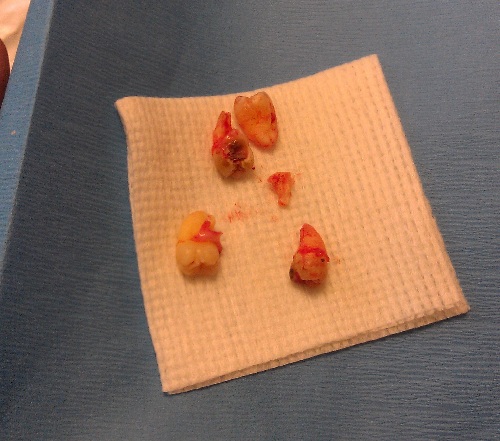
It does me. Or at least it did when I took it. But I was in a dentist’s office, next to someone who had just had her wisdom teeth pulled. These are them. Fresh with blood and bits of gum still attached.
But does it horrify? Probably not. It’s gross, but even if you’re disgusted, you’re probably not horrified. I bet you would be if it were human eyes, however. It’s just another body part, but the eyes are frightening to look at in a way that wisdom teeth aren’t: they aren’t supposed to be there.
It probably occurs to you when you see the teeth that they are supposed to be there. They are there with benign intent. But excised eyes on a tray carry horror with them because the backstory of how they got there would likely be at the very least gruesome, if not terrifying.
The story that we attach to images makes all the difference. The microhorror section of this site trades in that currency. I allow myself 500 words to give a backstory to a random picture that I may have taken or been given, rooted in the horror genre. Some of them are not so easy. Others, like these teeth, are too easy and need a story that throws the reader off.
Head over to Mistfortune 500 and check out the tale I spun to go with this image. I timed it, they take about two minutes to read. If you like it, there are more.
That’s me, over on the right, with the snazzy wristband.
Last week I offered a question regarding art and entertainment: what is the difference, to you? How would you define them? Is there a grey area where the two are intertwined?
Now, let me ask you a more specific question: what is the difference between a cover band (performs songs they did not author) and an original band (performs songs they did author)?
If you follow this blog, you may know that I’m a musician. You may have even listened to some of my work. Much of it is free and linked to here. I create original music, and it is art. At least to me. And I do it for me: I would still be writing songs if I were hopelessly stranded alone on a desert island, but that doesn’t mean I’d like it that way. I love sharing the work. The times that I have witnessed others being moved by it are very memorable. Milestones of achievement. I think of myself as an artist, but I am certainly to some degree also an entertainer, simply by virtue of making art in the first place.
Around the end of my college days in Las Cruces, New Mexico, in perhaps ’02 or ’03, I played in a hard rock/metal outfit called Hypertension. We were a three piece that wrote all our own material and played gigs as often as we could. I played guitar and sang, and Dennis and Mike (yep, two Mikes in the band) covered bass and drums, respectively. The songs we wrote were a collaborative effort between us, though for the most part each of us composed for our own instruments. We had some great times, and a strong camaraderie.
I recall one night we played at a venue creatively named The Club. Like the setup at Bob’s bar in Rome, NY that I described last week, there was little to distinguish stage from listening area. I stood in front of a packed bar and played songs that we had composed, and lyrics that I had written in the private crucible of meaningful, introspective catharsis. I belted out the words to expectant faces only a couple feet away from mine, and they were watching, paying attention. Some of them knew the songs, and sang them right back at me. They knew the words. They’d taken these songs home and listened to them, connected to them, and come back to see the songs performed again. This was one of the best moments I’ve had on stage. The way my message was not just heard but felt. I was received.
But some gigs were not so wonderful. Another night, we found ourselves in a playoff for a battle of the bands. The venue was huge and far too well lit, and there were tables and seats arranged in a huge square around the dance floor that the stage looked out over. The audience sat in place in the square and stared, like judges at a panel. Mildly sipping their cheap drinks. They did not applaud our songs. They cared nothing for our work. Deathly silence and vacuous stares from distant onlookers is, to most, worse than boos. Add to that an incompetent soundman who hated us for not doing his job for him, and members of another band who attended only to stand just off to the side of the stage and heckle us, and the evening was shaping up pretty awfully.
Another metal band called Ferrum played after us that night. A real class act, these guys were. But again, they played original music and the audience was having none of it.
The final performance went to a group whose name I cannot remember, of kids with brand new equipment clearly bought for them by their parents. They were a few boys and one or two girls, all high school most likely, all excessively thin and dressed in the latest fashion. They got up on stage and played covers. Skynyrd. Seger. Petty. And they played them badly. Horrible timing, poor tuning, not remotely tight. It seemed that they’d never used microphones before. But the audience roared to life. They approached the stage. They hollered, they danced. They had a great time.
I don’t blame the band for being a bunch of kids playing covers. That’s fine. And honestly you can’t blame people for wanting to hear the same old songs they’ve heard a hundred times, performed poorly by shallow children. It’s shitty, and any real fan of music would at least vaguely appreciate those who try to create it from scratch and do it with some skill, even if the song doesn’t immediately inspire them. But ultimately I don’t think the audience ignored Hypertension and Ferrum out of malice. I think they were just bored. Unmoved.
But there is a fundamental difference between what we did and what the cover band did, and it’s the same difference between every cover band and original band. One is an entertainer, and one is an artist. One is focused on performing for a response, and does not dive deep, does not speak from introspection, does not create art. The other does these things and allows the performance to be a secondary goal.
At the end of the night, the soundman decided a winner by standing in the middle of the room with a decibel meter and prompting the audience to cheer for the band they liked best. Ferrum and our group knew we were going to lose to the infantile hacks that came after. So, when it was time for the applause to be gauged, we walked out on the stage together, stood in a line, crossed our arms, and turned our backs on the audience. Little more than half a dozen men, defying a room full of musically shallow dolts. They booed us hard. The boos might even have been louder than the cheers when the soundman called the final band’s name. To this day I have not been booed on stage other than this one occurrence. It is a unique experience.
After this, because we were dudes in bands, much drinking followed between Ferrum and Hypertension. And friendships. And promises of working together on future shows. The members of the cover band were not allowed to drink, since the bar would not serve minors (and did not serve Hi-C or Kool Aid anyway). They left after receiving a personal congratulations from everyone in the establishment save the half a dozen long haired men in black sitting at the bar.
Conflation of cover bands and original bands still irks me and I get drawn into arguments over it from time to time. Yes, they both play you music while you slurp your drink at the bar. But no, they are not the same. One is bringing you their own art. An expression of the deepest, best within themselves. The other is trying to bring you a facsimile of someone else’s tired old art so that you will clap and they will get paid. For me, this is the difference between art and entertainment. This.
A band I cannot recall the name of playing at Pollywogg Holler in Belmont, NY, 2016. They had to hike their gear through the woods to play to a handful of folks that day.
Last week I talked about the aim of performing music, and today I’d like to shift to a related subject that often comes up in conversation when live music is discussed: the difference between art and entertainment.
At its core, art is the doing and the product of human creative skill, that results in something that is pleasing to behold for its beauty or emotional power. Entertainment is the creation and presentation of something that provides amusement or enjoyment. When one creates art, they have simultaneously created entertainment. When one entertains, they draw upon art to craft the presentation. These definitions overlap, but where does the overlap end?
Take for instance a television show wholly meant to entertain, like Family Guy, Modern Family, or The Big Bang Theory. These are money-making vehicles that survive based on their popularity. They are created to please people who are not looking for emotional power or inspiration, but rather something that amuses them, maybe gives them a giggle here and there.
But is there not art in these entertainment endeavors? Of course there is. The writing, the lighting, the set design, the acting methods, the makeup, the sound design, the comic delivery… and the list goes on. These are the products of art, works of creative skill that birthed something inspiring to behold. You may not perceive or connect with the use of subtle choreography by a director to achieve the maximum comic effect, or the vocal inflections utilized by a professional actor to do the same, but these techniques are art. It could even be argued that the cheap gag they are used to create is art, in the way its writer created it. So why then does cheesy TV seem so very not artistic?
Or, take for instance Bach’s Ninth Symphony. This is near universally regarded as a work of art. Listening to it evokes the feelings that art is meant to tug upon. And there is no doubt that great creative skill went into its creation. Owing not only to the skill level but also to the uniqueness of each of us, literally no one else in any time in history could have made that particular piece of music, except Bach, right when he did.
But is there not entertainment in this art? Of course there is. Bach himself would cite practical reasons for composing it, having to do with money, station in life and in society, and the pressure of expectation of his peers. We see these as coals that fuel the furnace in which his creative work was forged, but they are wrapped up in his work nonetheless, just as what The Wall represented to Roger Waters is caught up in the music and art that spun from it, and just as performance and financial needs drive a band to tour, or drive a painter to set up showings.
There is a perceived dichotomy between art and entertainment that arises at least in part as a contrarian response to the understood significance of each thing. One is deeply personal, profound, and represents the best in us. The other is pandering for attention or gain. Artists reel at the suggestion that their work is entertainment. But, as it happens, not at the suggestion that their work is entertaining.
Because all artists create things that bear the ability to move others. It’s part of the work. An artist creates for themselves, because they must. And they make work that moves them; this is how they know it will move others. From the start, the desire to make something that people will enjoy is a part of the process. And that is entertainment whether they would claim it or not.
So where do we draw the line? Perhaps the more pertinent question is, do we draw one at all?
Friday, my metal band Outnumber the Living played a show at Trick Shot Billiards in Clifton Park, New York. The show went well. Everyone had a good time, and the response was above average. The band had been looking forward to the show for a few months, and carefully prepared the set of five songs we’d perform, roughly half an hour of music, going over them as a group in our rehearsal space until we not only performed the songs well individually but also achieved that sought-after character of polished musical ensembles: tightness.
The turnout at this show was good. The promoter managed to cover the headliner’s guarantee, all his own costs, and give the bands a small amount as well. The gathering area at Trick Shot feels open, and the comfortable places to drink and talk are tucked away from the stage. Patrons that show up tend to hang back where the sitting tables, bar, and pool tables are. Even those watching the performers tend not to crowd the stage unless the place is full. But even with a respectable number of customers, Trick Shot feels sparse.
As a performer, this is less fun. Folks who don’t perform don’t realize the way that the stage and its lighting obscures the audience from you and makes them feel far away. Typical stage lighting doesn’t just illuminate the performer so you can better observe them as they show you what they’ve worked on, it also separates them from you in a meaningful way, much as the stage does. There is an artificial barrier between the audience and the stage, that both sides willingly observe.
But this is not a bad thing. The barrier is created and observed by bands and listeners alike willingly, because there is a reward in this behavior: breaches of the barrier bring enjoyment. The performers bring the audience something meant to evoke, and the audience gives back in the form of visible and audible enjoyment of that effect. This bridging over the artificial gap in the room is the act of deriving a connection to each other.
Applause is the most common form of this, but at small, standing-room shows like those that a band like mine would play, more is appropriate: the audience is given an inferred and at times verbal invitation to approach the stage. Pressing that boundary between the display and the onlooker creates excitement. Closing the gap between the messenger and the receiver. Exhibiting, face to face, the effect that the message has had. There is a deeply gratifying emotional communion possible in the performance of music and the audience is responsible for creating it, not the performer. The act will proceed as rehearsed, and the actors will display what they mean to, for you. But it is up to you to give it back. To embrace the feeling and to show the performer that they are being heard, in the most profound way.
The boundary between these two parts of a show is drawn by the stage, which is often short, and sometimes even physically indistinguishable from the rest of the room. And it is also drawn by the lights. The way they paint colors and thereby provoke feelings about the performer’s presence and the material being displayed. The importance of a light show is often underestimated; it makes up a good deal of what you take from a show. It, and the lack of lights in the listening area, set a mood and delineate the zones where the emotional roles of the messenger and receiver are apt to form.
Perhaps unfortunately, being on stage and having those lights aimed at you makes you less able to see the audience. In some cases it is entirely blinding. The performer can feel alone up there. And a lukewarm response can feel more chilly than it is.
There was a show I played years ago with a couple of the same fellows that are in Outnumber the Living now, in a small town in upstate New York called Rome. In Rome there used to be a dive bar run by a man named Bob. Bob was a nice fellow, and he ran sound for the bands he invited to perform in his tiny bar. We played there twice as Son of Mourning before the bar was shut down by health and safety officials.
When we first arrived, we were surprised at how small the stage was. It and the standing room where the show would be watched was around the size of a living room in an average home. The floor was a uniform checkered tile, and there was no separation between the performance area and the rest of the room. We were told to set up on the far end. “Over there,” Bob said.
We played later in the night, and the only people in the bar were Bob and members and friends of another band. In the performance room there were half a dozen, or maybe ten people aside from myself and my band’s membership. The lights went out and we played, like we always did, but there was no boundary between the stage and the audience. We stood looking each other in the face, in the same darkness, at the same height. Nothing, not even monitor speakers, created a gap.
And it was one of the best shows I’ve ever played.
The audience and the band mixed. They stood among us. Between us. Our vocalist leaped into their midst, even rode their shoulders. I stomped the ground with particularly important downbeats, and the old wood floor thrummed under everyone in the room. They screamed back, both the lyrics they picked up from the songs and also just screams, the guttural feelings made vocal. They stomped back. In the dark and tumult, the expressions on our faces were hard to make out, and there were none that would not be forgiven. The messenger and receiver blended so thoroughly, that the message and the response obliterated the space between.
That is the aim of a performer. To foster an emotional communion. To say, “See this thing and feel it,” with the express aim of being told, “I see it and feel it.” This goal can be detracted from by a prideful, posturing performer or a reluctant audience. But it remains the hope, the dream resting in the heart of anyone ascending the steps and assuming the mantle of the attention of a room full of expectant faces. And for those of us who have received this message before, it is the hope we carry with us as audience members as well.
Have you deeply enjoyed a concert before? What made it so important to you?
Greetings and welcome back. Last week’s entry unveiled a new top-level page here at The Octopode, all about Salamander City, the forest acreage and log cabin I work on every week. If you missed it, head on over and check it out. It will be an ongoing subject of future blogs here.
Today I’m unveiling something else for you, unrelated: a new Misfortune 500! Let me ask you, what does the picture above make you think of? If you had to spin a very short horror tale around what is in that picture, what would be about? Take 120 seconds to read 500 words of horror having to do with that image, I fucking dare you.
Now, for a little bit of content specific to today’s title.
On March 10, my dearest friend and closest companion finished his sixteen years of life as a canine on planet Earth. Blake was, simply put, the best. I adore him. His passing and his absence have been extremely difficult.
Friends, and the vet who helped me let him go, have given advice and a shoulder to cry on. Donations were made in his name to animal welfare organizations. Cards were sent. Gifts. It’s been really nice to have people looking out for me as I travel through this grief.
One of the things that was recommended to me by the vet is to write a memoir of Blake’s life. Upon receiving this suggestion I immediately thought of two important lessons I’d already learned the hard way: first, writing has always been a balm for me. I’ve set down volume upon volume in efforts to grapple with pain in the past. Second, I know that when I am in a state of grief, I must take all advice that is given, on faith.
And that is a bit of wisdom I’d pass on to you if I can: when you are in pain, you can only gain from following advice given to you.
Even if it’s not good advice, you will gain the experience and the knowledge, and you will be actively working toward your own betterment, which is significant regardless of what it entails. Plus, when you’re in a hard emotional place it is difficult to think critically about advice given to you. You can’t trust your own valuation of such things. So, just take the advice that is given by people who care about you. Do the thing. You won’t regret it.
Now for my question to you. I decided to abstain from reading about memoirs. I have read autobiographies but never memoirs, and I am completely unfamiliar with the style. I don’t even know the form. The voice. The intent. I felt that just diving into it and trying to find what felt best to write would be the most therapeutic way to handle it. And it’s working. As memories occur, I relish my next writing session when I can set them down in the memoir.
What is your impression of writing therapeutically, and do you choose to freewrite or use an established form for this? Do you share the work? Do you even revise it?
Greetings, everyone. Thanks for dropping by The Octopode today. If it’s your first visit here, I hope you’ll take a look around and see what’s available. There’s music, and fiction, and this blog, which contains many discussions, rants, and explanations of things that have worked their way into my brain and begged to be worked back out of it and into words. In the months leading up to this post I’ve talked a lot about psychology, morality, and goal-oriented thinking. But now I have a new topic to present to you, that I have long anticipated discussing here.
Today’s blog post will be the first in what I hope to be many, though mayhaps not consecutive, posts about Salamander City, which is the name I’ve given to a couple acres of forest in the Adirondacks that I came to own in 2015. The plot has on it an old, unfinished log cabin that has been neglected for a long time. It is my goal to complete, restore, and build out the property into a getaway, second home, and emotional oasis.
I know that a lot of you out there can relate to my desire to do this. You may also relate to me in that I have very little knowledge of woodworking, landscaping, or construction. Aside from a few simple projects I completed in woodshop way back in high school, I came into this challenge with no know-how. What I did know is that I was capable of learning. And the rewards for tackling something this huge and so far from my working understanding would be enormous. I just had to focus, think, plan, work, and learn by trial and error. We’re all capable of this, but I find that not many of us are willing to admit that.
It’s my hope that you’ll delight in reading about the project and what it means to me as I move forward with it and, in time, reach my goal. Along the way I’ll discuss the work itself. The tools, the materials, the practical methods. I’ll describe the problems I encounter, the plans in development, and the accomplishments, as they come. I plan to share pictures and even video to better transport you here and show you what I’m up to. And of course, foster discussion. So many of you can offer me real advice and helpful instruction. My course is often altered and improved by comments that come from unlikely places.
So, let me wrap this up by sending you to a new page set up here at The Octopode for Salamander City, where you’ll find an introduction, some pictures, and over time a growing menu of blog entries like this one that are about the project. I hope you’ll return again and again!
A friend of mine collects coins. He isn’t all that interested in their trading value, and mostly he deals in pennies. Large volumes of them pass through his careful gaze, slid across a table and his attention just long enough to catch salient details: date, location of mint, condition. Then they go into one of a few piles depending on what’s next. Most go back into circulation, but a few are special. They possess the right combination of unusual characters to make them rare, and to someone like him, that is precious. Chief among these characters is age.
I gave him a large glass bottle of pennies I’d been collecting for years so that he could look for anything he liked, and one solitary penny in the whole group caught his fascination. It was an older penny that just happened to be in very good condition for its age. He was certain, he told me, that it had come from someone’s collection. Someone had cared for it, kept it safe from wear and even from the harm that uncontrolled environmental air can inflict upon copper. Someone gave a real shit about this particular penny, that I had probably been handed by a convenient store clerk to break a bill I spent on an eggwich and coffee. They’d looked at it with a magnifying glass. Written down its details. Looked it up in current publications made by others bearing this same preoccupation with coins. To me, it looked just like any other newer penny. I might have left it in the give-a-penny-take-a-penny tray.
Once, I asked him why he spent so much time sorting and inspecting pennies. To be honest, I said, to me it seems quite boring. Like counting beans or sifting gravel. He explained that some were special, like the old collector’s penny that I’d given him in a jar with hundreds of others. But why does it matter, I asked. He said that it was just fascinating to hold that little piece of history in your hand.
Human beings’ obsession with things that have stood for long years is visible everywhere. The veneration heaped upon old ideas, old buildings, old land, old institutions. Fictional characters that have lived for multiple lifetimes are cast as wise, powerful. Trees that have endured centuries are protected. We see the aged things among us as carrying an intrinsic value associated solely with the passage of time that it has withstood. Why do we not tear down historical buildings to make room for new ones that will be built with better craftsmanship and materials? Why are we reticent to replace old ideas with new ones that have learned from and improved upon the old? Indeed, many of us refuse to even believe that anything new could be better than the old, and cling to the ancient under the notion that it is somehow better, even when this can be proven untrue.
Is it because we remember the old thing, and resist change? Is it because we cling to traditions and established ways, a known human trait? Is it because we hope to achieve some sort of immortality by extending our influence beyond the scope of our lives (more about that here)? Are old things symbolic to us of other things we value, like an event, a person, or a time gone by? Is it the long-established lack of mystery? If we know a thing, we are more likely to trust it to be what it is than to try out something new, right? Is there a purpose relevant to the present moment that the protection of something from the past serves? What is the root psychological purpose of preserving, say, a historic location?
Welcome back to The Octopode. If you’re joining us mid-topic, here’s a summary:
Last week I made the claim that the value of hard work lies in the way it forces one to culture self-esteem. I then drew a direct line between everyday modesty and the denial of the self. Today I’m going to proceed from this premise to make the original point clear.
In another topic I recently I stated, “Emotionally, the value of successfully working toward a goal is far greater than the value of successfully achieving that goal.” In that statement I was invoking the value of hard work, though tangentially. I was implying that the act itself carries great value, and it does. The mechanism by which it does this is by culturing self-validation, and proving to the self that it has value by proving that it is effective.
The formula is very simple: Stated Goal + Hard Work = Accomplishment ±Result
Like a proverb, the above seems simple and intuitive, yet in application the effects are broad and deeply significant. It is a basic truth of our psychology and a fact of nature, not nurture. That is to say that it’s as human as farts and you don’t need to be told how to do it.
The plus-or-minus symbol preceding the Result in the formula is of great significance. The result of the hard work, while important, is not required for this formula to work. Cumulatively, human societies put far too much emphasis on the result of labor rather than the labor itself. Consider the way this devalues the work itself, and by extension, the worker. Imagine how crippling total primacy of the result would be for the one who undertakes the task of reaching it. And this is true of the writer who is so concerned that their book must be a success that they find themselves unable to write at all, to the farmer who isn’t sure that their crops will yield enough to pay for the winter’s resources and spring planting. The threat of a failure that to some extent is beyond the actor’s ability to prevent takes away their ability to act, for fear of consequences outside their purview and prediction, always looming and developing.
But it is in the work itself that the value is received. And there is where the emphasis should always be. This is because the work is the more significant accomplishment. The writer who failed wrote a book. Yes, the market rejected it. Or the editor did. Or it sucks, the author realized after the fact. So? These outcomes were uncontrollable from the get-go. The writer succeeded in doing what they set out to do: write. The farmer is similar. Though his failure will result in more concerning outcomes, and this makes it difficult to de-emphasize the result, he has still done what he set out to do. He has toiled hard and farmed the best he could. He may now be faced with poverty, but he has validated himself and, hopefully, another opportunity to make his house whole again will come to him soon.
The writer whose book fails and the farmer whose yields fall short of budget have reached accomplishment, and if they bemoan themselves or become angry with themselves, it is because of only two possible reasons: they did not do their best to begin with, or they put too much value on the result.
I know, I know. It’s easy for me to say, since I’m not a farmer trying to support a family. And you’re right, and I have no defense for this. But I hope that this example helped pare away the fluff surrounding the concept of self-validation that I have attempted to elucidate.
Hard work takes time, and whole-self dedication. It requires that one apply themselves rigorously. And afterward, you feel positive. Not just because you have this thing you’ve worked on, but because you have worked on this thing. It validates you. It forces you to acknowledge the efficacy of you, even if the work does not lead to a useful result. It is a mirror that shows you the value of doing.
There is this psychological concept of flow as a state a person enters into when applying themselves fully. It is the basis of occupational therapy. There is a peculiar set of things that occur to someone who is in flow, or in “the zone”, as some call it. It is a profoundly positive thing, and the basis of self-esteem. The proof that you are capable, effective.
And that is the grounds upon which my original claim lies. When you work hard, you prove your value to yourself whether or not you want to believe it. Even the self-deprecatory or self-hating individual must go out of their way to devalue themselves after working hard and truly applying themselves.
Those of us who loudly endorse the value of hard work do so because we have felt the way it fills us with esteem. The way it gives meaning to everything in our lives. And we despair to see it lacking in others. Some would go so far as to say that there is a great sadness in the world that comes on the back of modernity directly due to the leisurely lifestyles of the privileged in a world that no longer forces them to sweat and bleed just to get by.
Today I’m going to bring up a very old value and explore it with you a little. What I’d like to discuss is the idea of the value of hard work.
What is it? Where does it come from? Why do those of us who know what it is feel so strongly about it?
I have developed a theory about it, and it’s coming today because it flows naturally from the assertions I’ve made in this blog in recent weeks. I propose that the reason those of us who value hard work do so with such force, is because it prompts us to short circuit the guilt and self-denial that robs us of the ability to achieve real self-esteem.
It comes down to being able to savor your own accomplishments. We all know people who can’t do this. You might be one yourself. Always giving credit where it’s due unless in regard to your own achievements. Mild rebukes to appreciation like, “Nah it was nothing,” or, “I was only doing what anyone would have done,” or the like are assumed to be expressions of modesty, but are they really? Is modesty even virtuous?
To that last question I would answer: sometimes. As long as credit is given where it is due. Being unpretentious is fine; it is a form of honesty. But denying the value of your deeds is not.
These folks tend to be assiduous in giving credit where it’s due because they believe in the principle of doing this, and this underlines the significance of their own rule of not accepting credit for their own labor and/or wise/generous choices. They know that a good turn deserves appreciation, and so their denial of it holds meaning.
They tend to be achievers too. Do-gooders are often this type. Looking out for their fellows, and keeping themselves in order well enough to continue in this fashion. Stringing along accomplishment after accomplishment, and sidestepping the reward offered by those whom they have helped.
What they are really doing here, is denying the self. They are committing themselves to the absolute altruistic ideal that the self does not matter, only what one can do for others. They are acting “selflessly” in an effort to do the right thing, and therefore it would be the wrong thing to accept credit for it. And indeed, we live in a culture that greatly values denial of self, destruction of pride, omission of ego, and total dedication to the betterment of anyone but oneself. That is a rather involved subject for another discussion perhaps, but for the sake of this conversation let’s just agree that accomplishments are good, helping others is good, giving due credit is good, and holding oneself accountable for all one’s good deeds, is also good.
There is nothing morally positive about discounting one’s achievements. Modesty, when it is a denial of reality, is a corollary of self-killing altruism. These people throw away the value of the good they’ve done and believe this is a righteous act (notice also that acting righteously is itself a contradiction of modesty). They work to do what they say they believe is right, then belie the same act’s rightness by blanking out the goodness of the act. It is a lie, and it is done under the pretense of a lie, which is rooted in self-hate.
And the negative effects beyond this are long-reaching. It may result in an irrational fear of death due to failure to meet real goals, as per the topic discussed here in the last two weeks. It may result in failure to state one’s goals and think them through, preferring to evade that kind of self-oriented thought. This results in a life filled with a long string of small accomplishments and the failure to do what is truly important to the individual. And the scope of one’s own life is not considered, since no goal-planning is effectively conducted. We talked about the value of this in the Grok Death topic.
Today I’ve drawn a line between self-hate and what is typically considered virtuous modesty. This is the first step in making the point I stated at the beginning of this entry, which is that the value of hard work lies in the way it forces one to accept self-esteem. Next week I’ll tie up these assertions to show the mechanism.






 The Octopode