Category: writing

How Short Can You Horror?

worm

Another month, another Misfortune 500.  Very short tales I come up with to go alongside random images.  The pic above is a banana peel with a bit of stringy banana material on the end of it.  I thought it kind of looked like a worm.

I’ve talked before about how the backstory is what makes the pictures into horror, or into whatever you’d like.  You, the writer, have all the power.  How many words do you need to exercise it to your satisfaction?

Check out the story I set down to go with this image here.  C’mon, it’ll take two minutes.  Lemme know what you think.

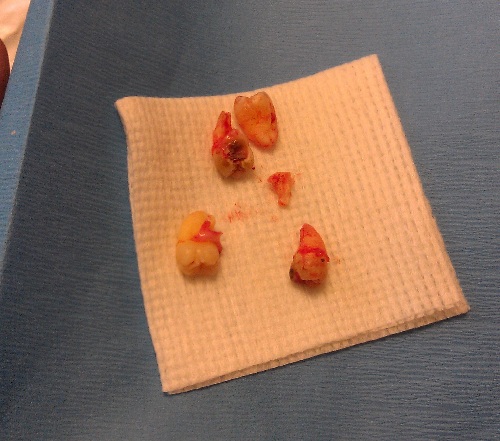
Eeeeew Teeth

teeth
Gross, right?

Does the image above make you uncomfortable?

It does me.  Or at least it did when I took it.  But I was in a dentist’s office, next to someone who had just had her wisdom teeth pulled.  These are them.  Fresh with blood and bits of gum still attached.

But does it horrify?  Probably not.  It’s gross, but even if you’re disgusted, you’re probably not horrified.  I bet you would be if it were human eyes, however.  It’s just another body part, but the eyes are frightening to look at in a way that wisdom teeth aren’t:  they aren’t supposed to be there.

It probably occurs to you when you see the teeth that they are supposed to be there.  They are there with benign intent.  But excised eyes on a tray carry horror with them because the backstory of how they got there would likely be at the very least gruesome, if not terrifying.

The story that we attach to images makes all the difference.  The microhorror section of this site trades in that currency.  I allow myself 500 words to give a backstory to a random picture that I may have taken or been given, rooted in the horror genre.  Some of them are not so easy.  Others, like these teeth, are too easy and need a story that throws the reader off.

Head over to Mistfortune 500 and check out the tale I spun to go with this image.  I timed it, they take about two minutes to read.  If you like it, there are more.

How Do You Write Therapeutically?

house

Greetings and welcome back. Last week’s entry unveiled a new top-level page here at The Octopode, all about Salamander City, the forest acreage and log cabin I work on every week. If you missed it, head on over and check it out. It will be an ongoing subject of future blogs here.

Today I’m unveiling something else for you, unrelated: a new Misfortune 500! Let me ask you, what does the picture above make you think of?  If you had to spin a very short horror tale around what is in that picture, what would be about?  Take 120 seconds to read 500 words of horror having to do with that image, I fucking dare you.

Now, for a little bit of content specific to today’s title.

On March 10, my dearest friend and closest companion finished his sixteen years of life as a canine on planet Earth. Blake was, simply put, the best. I adore him. His passing and his absence have been extremely difficult.

Friends, and the vet who helped me let him go, have given advice and a shoulder to cry on. Donations were made in his name to animal welfare organizations. Cards were sent. Gifts. It’s been really nice to have people looking out for me as I travel through this grief.

One of the things that was recommended to me by the vet is to write a memoir of Blake’s life. Upon receiving this suggestion I immediately thought of two important lessons I’d already learned the hard way: first, writing has always been a balm for me. I’ve set down volume upon volume in efforts to grapple with pain in the past. Second, I know that when I am in a state of grief, I must take all advice that is given, on faith.

And that is a bit of wisdom I’d pass on to you if I can: when you are in pain, you can only gain from following advice given to you.

Even if it’s not good advice, you will gain the experience and the knowledge, and you will be actively working toward your own betterment, which is significant regardless of what it entails. Plus, when you’re in a hard emotional place it is difficult to think critically about advice given to you. You can’t trust your own valuation of such things. So, just take the advice that is given by people who care about you. Do the thing. You won’t regret it.

Now for my question to you. I decided to abstain from reading about memoirs. I have read autobiographies but never memoirs, and I am completely unfamiliar with the style. I don’t even know the form. The voice. The intent. I felt that just diving into it and trying to find what felt best to write would be the most therapeutic way to handle it. And it’s working. As memories occur, I relish my next writing session when I can set them down in the memoir.

What is your impression of writing therapeutically, and do you choose to freewrite or use an established form for this? Do you share the work? Do you even revise it?

How do you use writing as therapy?

Comment below.

Three’s a Crowdypants

Did you know that a group of otters is called a romp?  And a group of vultures is a wake?  You might.  You just might.  I mean, you knew that a group of crows is called a murder, right?  But did you know that a group of squid is a squad?  That’s right, a squad of squid!

A group of zebras is called a dazzle.  Easy to understand, right?  A group of flying swans is a wedge.  Some aren’t so easy.  A group of turtle doves is called a pitying.  A gerund?  Really?  Others like this include the chickens, called a chattering, and ducks, called a paddling.

A group of thrushes are called a mutation.  Wha???  A group of ferrets are called a business.  That one makes sense.  But a group of gnus are called an implausibility.  Huh?

Foxes:  a skulk.  Emus:  a mob.  Flamingoes:  a flamboyance (oh come on, is this alliteration for giggles or what?)

Anywho, I came up with some fun ones for additional fun fun funsies.

A group of rocks:  a hardly
A group of earthworms:  a spaghetti
A group of bats:  a flappy
A group of raccoons:  a masquerade
A group of penguins:  a formal
A group of hares:  a beard
A group of eggs:  a breakfast
A group of termites:  a board
A group of clams:  a clap
A group of bears:  a fuzzy
A group of Woody Harrelsons:  a Forest Harrelson
A group of squiggles:  a squoggle
A group of groups:  a groupgroup
A groupgroup of groups:  a groupgroupgroup
A group of beds:  a sleepy
A group of boats:  a floater
A group of frisky cats:  a cat-astrophe
A group of sloths:  a loaf
A group of lit sparklers:  a sparklocalypse
A group of cows:  a cowncil

What are some of yours?

To Boldly Split Infinitives

Ever since I started taking writing seriously (catch me on most days and I’ll tell you I still don’t) I have been amazed at how fluid the rules for grammar, and in fact all of writing, are.

As kids in English Class, we’re taught how to follow the rules. You don’t end sentences with prepositions. Passive voice is always wrong. Never split an infinitive. Hard and fast rules like that are good for attention-deficient sproutlings like the ones that shared my high school classrooms (and me, of course. I was mostly thinking about boobs and lizards and Megadeth in those days), because telling a fifteen-year-old to do something is hard enough without having to tack on an exception or two or nine.

But still, one of my English teachers (thanks, Mr. Furlow) made a point of saying at least once that the reason you learn these rules is so that you can break them. Read any accomplished author, he said, and see how many times they break the rules. That, of course, mostly just fueled apathy toward the subject, but that portion of the lesson stuck with me more than anything—even more than the endless sentence diagrams we were all inculcated with.

These days I find myself frequently researching the proper use for punctuation. I just spent an hour working on how best to use ellipses in Shame the Devil. I overuse them, I’m told, but I choose to stick with the usage I know. I also don’t put spaces before, after, or inside of them. I don’t add punctuation at the end of an ellipsis if it precedes a dialogue tag. I use them when dialogue trails off AND again when it picks back up, if it picks back up at all. But I don’t do this if it doesn’t feel right for the character’s rhythm of speech.

All of these strategies are advised against by some, and are endorsed by others. There isn’t a rule of rules to go by, that has since been re-thought, nor was there ever a rule which was slowly perverted by repeated misuse. It’s author’s choice. Always has been. Just about the only hard and fast rule there is in such matters is to be consistent inside the work (and I’m ready to see an example of why this rule should be broken, too).

I run into this situation any time I research a usage issue that isn’t obvious. And by obvious I mean there’s little point in breaking a rule that doesn’t accomplish anything. Why use a semicolon when a question mark is called for? Why omit an apostrophe from a contraction? You’re just going to look stupid if you break a rule for the sake of breaking it. Don’t be a punk.

But overuse of ellipses or dashes? Look what it did for Emily Dickinson. Offsetting internal dialogue instead of working it into the character’s unquoted voice? Ever read Dune? How about Cormac McCarthy…I mean um…just LOOK at his work.

My point is, they (and many others) broke the rules and wound up creating something better. Sort of like when a band purposefully employs substandard production values in the recording studio, resulting in a more visceral/thrilling album. *Ahem* I am am NOT referring to the poseurs who dumb down their production for the sake of having a dumbed-down production.

I’m just saying that in the world of writing, as long as you’ve read Strunk & White, no one can beat you over the head with it anymore.

Breakin’ the law, breakin’ the law… I love it! Because guess what? It means we can do whatever we want. That’s great! Not because I just love to slop up my pages with whatever suits my fancy, but because creative writing ought to be as free as the inspiration behind it. The right tool for the right job, my dad would say. Composing fiction is a job, and writing is a tool that needs to be capable of it, no matter whose hands it’s in.

There will always be the grammarian elite out there, sneering at methods that don’t follow the “accepted” guidelines. “Accepted”, in this case, means whatever most people do. But who cares? Are you writing for them? I’m not.

But then, I’m forgetting my audience. If you are reading this, and you write, all of the above is probably very old news to you. But I felt like writing about it, dammit, and that’s good enough reason to do so. Motivation is the most valuable tool in writing, I think… Same as other arts. And I don’t have to spend it making sentence diagrams, analyzing Steinbeck, or coming up with lame acrostics using my school’s name if I don’t want to.

This isn’t English class anymore.