
What is it about new beginnings that makes them so exciting? The thrill of the unknown? Or, more: what makes us bite off more than we can chew when we start something fresh?
Let’s say that you love movies. You watch the special features on new DVDs, you read interviews with the production crews and the cast, you attend new releases the night they come out, sometimes go to advanced screenings. Or maybe you don’t. Maybe you just love movies and watch the same old ones you used to like, once in a while when you feel like it.
And you decide to become a filmmaker. How does that even happen? Do you start with your phone camera, taking little snippets of things and editing them together? Do you find a cheap or free video editing program for your computer? Maybe you want to be the next James Cameron, but you know as much about focal length and lighting a set as a fish knows about toboggans. Where do you start?
The bigger question is, how do you overcome the trepidation of trying to do something you’re not just unprepared to do, but vastly so? You have years of work ahead, dedication, perseverance, luck, trials, failures, and work, work work. How do you push yourself to pick up your little digital camera and start noodling with the buttons to figure out what the heck they do, on a given Sunday afternoon in the hour before you go get groceries?
Have you tried this? It’s extraordinarily difficult. Why decide to push a boulder up a mountain when you can just stroll by?
But that is what we do, so often. That is what James Cameron did, and any other great achiever. It is also what you do when you enter into a relationship with someone new, or sign a mortgage, or get a new job. You may consign its ups and downs to a simple daily effort, but it is a much larger scale project than that. And the projects you see as enormous, like a career in filmmaking, are made much the same way: with a simple daily effort, over a long time.
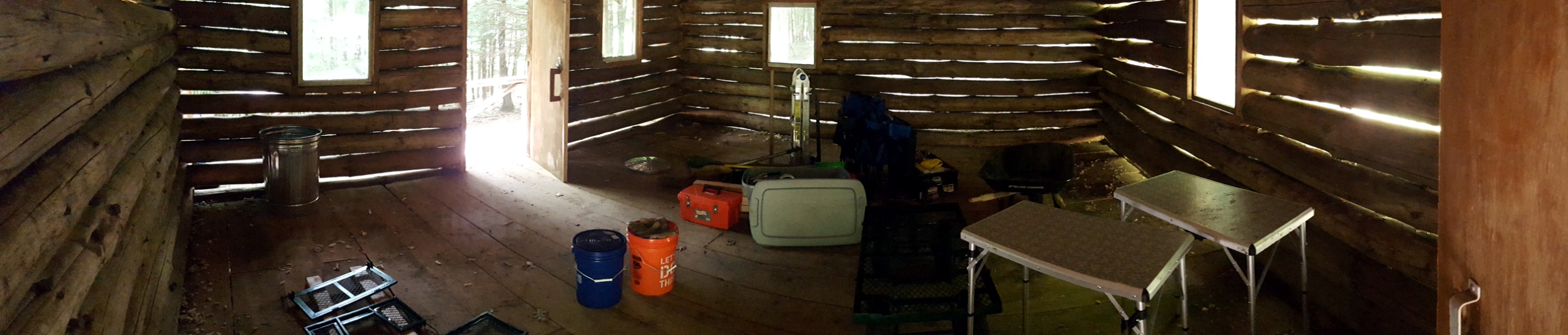
This is a panorama of the cabin at Salamander City, not long after I started in on it (click to see a larger image).
I tossed some things in there I thought I’d need. Gloves. A ladder. A table. Some water so I could stay hydrated while I tried to figure out what to do and how to do it. I didn’t know I’d need borate salts, or sandable silicon, or rust-proof copper meshing, or telephone pole pieces, or that I’d deal with an incompetent excavator or a quarry deliveryman or an angry retired county clerk, or that I’d learn how to heat a bath using a woodstove or divert water using a french drain or cut curved coping into logs to fit them together.
I just knew I wanted to try to restore and enhance this cabin and property. And the way to do it was one small step at a time.
This week a new page on this topic is posted here: Tabula Rasa part 2.
What gargantuan projects have you taken on, and how do you deal with the daunt?


 The Octopode